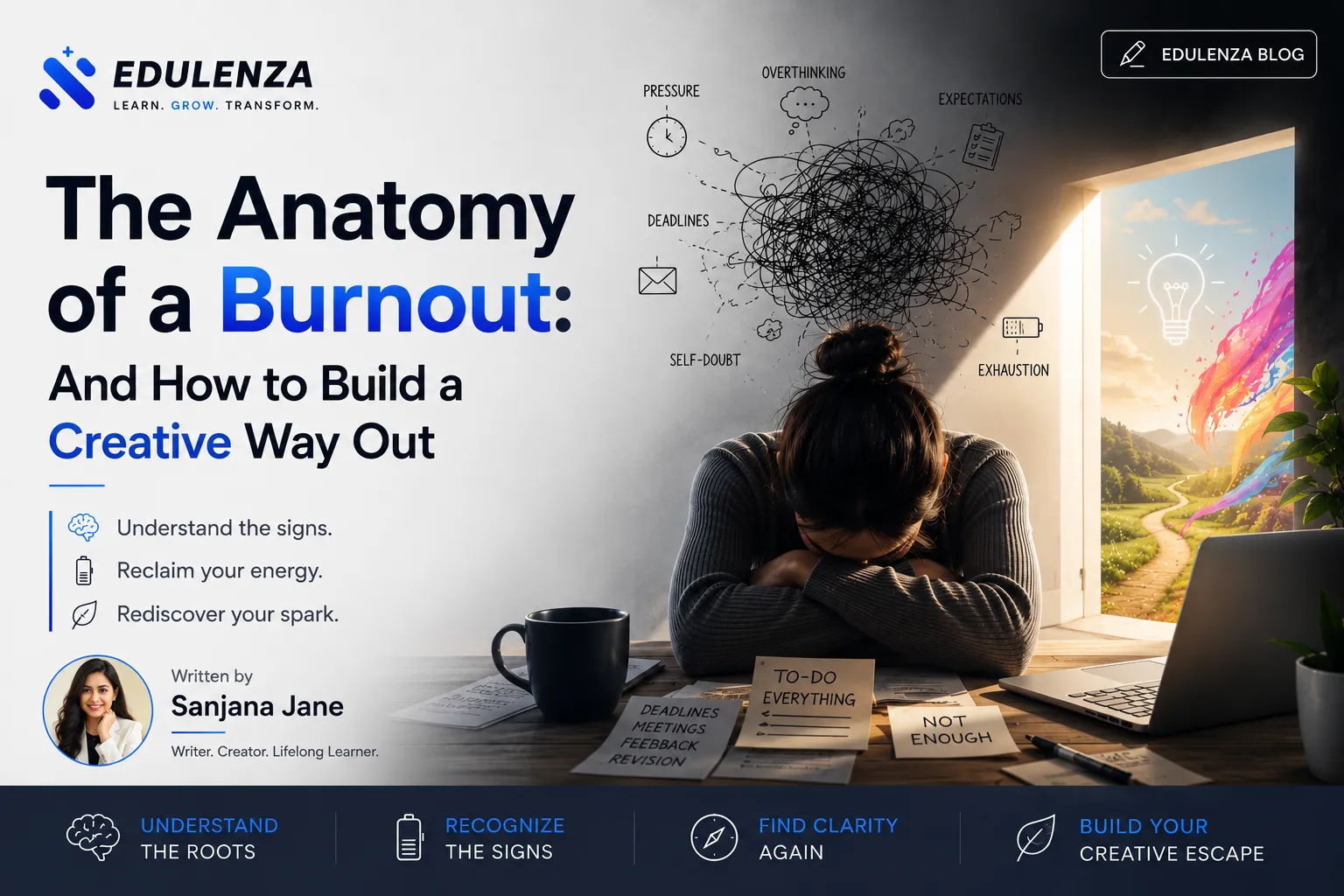
The Anatomy of a Burnout: And How to Build a Creative Way Out

by lamarka.edu
By Sanjana Jane | Content Writing Intern, Edulenza
As students, workers, or parents, we have all had those moments where we simply did not want to do what we were supposed to do. A slump. A sluggish feeling. A deep lethargicness, like you want to stop everything and stare at a wall. A mental block you can feel physically throughout your entire body. The passion or talent you once yearned for now feels like a burden far too heavy to carry, and all you want to do is set it down.
That, dear reader, is burnout.
The Evolution of Burnout
The term “burnout” was coined in the 1970s by an American psychologist, who initially identified it as a condition affecting the highly ambitious and overachieving. Decades later, it went mainstream, exploding globally in the early 2020s during the COVID-19 era, driven by the sudden shift to remote work and the rapid rise of the digital age. Millennials were, and remain, among its primary victims.
In 2019, the World Health Organization (WHO) officially included burnout in its International Classification of Diseases, designating it as an occupational phenomenon caused by chronic, unmanaged workplace stress.
It was the media, social and otherwise that amplified burnout into a global conversation, stretching its reach far beyond the office and into the lives of parents, caregivers, students, and creators alike.
What Is Burnout?
Scientifically defined, burnout is a state of severe emotional, physical, and mental exhaustion caused by excessive, prolonged stress, stemming from a range of factors including workplace environments, domestic responsibilities, and social pressures.
The WHO describes it as an occupational occurrence that wears down a person’s motivation and energy, leaving them feeling incapable, detached, and deeply pessimistic.
Gen Z, characteristically, has found its own vivid vocabulary for it such as “crashing out,” “brain fog,” “rotting,” and running on “zero social energy.” In simpler terms? The brain has been robbed, suddenly and completely of its creativity, passion, and drive. It becomes a blank page.
For Gen Z specifically, burnout is often fuelled by information overload, relentless digital connectivity, the pressure to monetise their passions, and an underlying fear of how to “make it” in today’s hyper-competitive job market. Their social battery depletes quickly, causing them to disengage from those around them, retreating into endless doomscrolling as a way to numb the emotional void.
It is important to understand that burnout is not laziness. It is not a lack of willpower. It is a biological, involuntary response and it cannot be fixed by a good meal or a full night’s sleep. It is also distinctly different from ordinary fatigue.
Burnout and the Unhealthy Coping Cycle
Perhaps the most damaging aspect of burnout is the coping mechanisms it breeds. People become impulsive, spend entire days in bed, binge-watch or binge-eat, quietly quit, settle for the bare minimum, and begin to resent the very things they once cared about. They grow avoidant, withdrawing from social connections and abandoning any effort to invest in themselves or others.
When Burnout Hits a Creative
Now imagine the weight of burnout on a creative person such as a writer, an artist, a content creator, a choreographer. When it strikes, they do not simply feel drained. They face an existential crisis, questioning the very passion upon which they have built their entire identity.
When a stock analyst has a bad day, it is a setback or just a bad day. But when a creator loses their ability to produce, it feels like losing themselves. Because for a creative person, there is no clean line separating who they are from what they make.
When the ideas stop flowing, a quiet, cruel voice appears in the back of their mind, convincing them that they never had any talent to begin with, and that everything they accomplished was simply luck. And being in their most vulnerable state, they believe it.
Building Your Creative Way Out
Recovery from burnout begins with a simple but powerful principle: you cannot keep making withdrawals without ever making deposits. You cannot keep pouring out without refilling. The brain needs to be fed, lubricated, and gently restored.
Try Something New, Something With No Stakes
Swap your regular routine for something niche, pressure-free, and playful. It can be something you never imagined yourself doing. Sit and colour. Pick up a hobby with zero consequences. The goal is to find ways to thrive, not just strive.
Brain Dump Journaling
Promote your flow of consciousness. Spill everything onto paper, no filter, no second-guessing. Let the thoughts come out messy and unpolished. No one will care or judge you for it. That is exactly the point.
Reduce Sensory Overstimulation
Pull away from people, places, or events that overwhelm you or stimulate you too much. Go for a quiet walk alone. Sit in stillness. Deprive yourself, intentionally and temporarily of sensory noise. Use this space to recharge.
Reconnect With the World Around You
Connect with nature. Go people-watching. Feed stray dogs. Do something small and kind and slow. Sometimes the most radical act of recovery is simply paying attention to life again.
Be Patient With Yourself
If your routine has fallen apart, do not force it back into place overnight. Doing something entirely different can help break the cycle but even that takes time. Give yourself the grace to heal. Consider this the break you have long deserved.
The Three Rs: Reset, Reflect, Reconnect
Once you have found what helps you recover, do not abandon it afterwards. Return to it regularly. Build yourself a way out of it and keep going back to it so that the building doesn’t collapse on you one day. Build it into your life as a non-negotiable, not as a cure, but as maintenance. You are not fixing something broken; you are redesigning and rebuilding something stronger.
For a deeper dive into recovering from burnout, explore the concept of Radical Consumption Alteration, a framework worth reading about.
Burnout is not the end of something. It is your body and mind asking and demanding for something new.
Your creativity and your imagination are not lost. They are resting. Trust them. Never lose hope in them, and never give up on them.
Ready to Rebuild Your Focus, Creativity, and Confidence?
Burnout doesn’t disappear with motivation alone.
It requires the right habits, skills, and support system.
At Edulenza, we help students, creators, and young professionals develop the life skills needed to thrive in today’s fast-paced world.
Through practical microlearning experiences, expert-led courses, productivity tools, and personal development resources, we empower learners to:
✅ Overcome burnout
✅ Improve focus
✅ Strengthen resilience
✅ Unlock their full potential
Whether you’re struggling with:
- Academic pressure
- Creative exhaustion
- Procrastination
- Self-doubt
- Information overload
Edulenza provides actionable learning designed for real-life challenges.
Your burnout is not a sign that you’ve failed.
It’s a sign that something needs to change.
Start building healthier habits, stronger mindsets, and a more balanced future—one small step at a time.
Explore Edulenza and begin your journey toward better learning, better productivity, and better well-being today.
Because success isn’t about pushing harder.
It’s about growing smarter.